
South America
From the Cerrado to the Pampas, two crops in a single season.
Overview
Much of South America’s large-scale agriculture is a recent achievement. Beginning in the 1970s, Brazilian agricultural researchers, led by Embrapa, learned to correct the Cerrado’s acidic soils and bred cultivars suited to the tropics, turning land once considered unproductive into one of the centers of Brazil’s grain, fiber and beef production. Farther south, the Pampas of Argentina and Uruguay combine fertile soils, a temperate climate and generations of farming and ranching.
Frontier Asset Partners is active in five countries in the region: Brazil, Argentina, Uruguay, Paraguay and Bolivia. In Paraguay, soybeans are grown mainly in the Eastern Region, while the departments with the most cattle lie in the Chaco, to the west. In Bolivia, almost all soybeans are grown in the department of Santa Cruz, and most of the cattle herd is in Santa Cruz and Beni.
For long-term investors, the thesis is less about opening new land than about producing more from land already in use—through second crops, integrated crop-livestock-forestry systems and the recovery of degraded pasture, an approach Brazil’s federal government has turned into a national program. The trade-off is more demanding due diligence: volatile currencies, land and environmental rules specific to each country, and logistics that weigh directly on the farm-gate price.
Production systems
How the land produces.
The Cerrado: soybeans, corn and cotton
Across Brazil’s Center-West, soybeans are planted as the rains arrive, starting in September; in the Matopiba region, the official sowing window opens only in late September or October. Once harvested, the soybeans make way for a second crop—corn or cotton—before the rainy season ends. This is mechanized, technology-intensive farming in which the rain window, mapped by Brazil’s official agricultural climate-risk zoning, sets the calendar and the outcome of the second crop.
Pasture-based beef
Brazil’s beef is produced predominantly on pasture, although feedlot finishing is on the rise. Integrated crop-livestock-forestry systems, developed by public research, combine crops, grazing and, in some cases, trees on the same land—one route to restoring degraded pasture and producing more without clearing new land.
Coffee
Brazil is the world’s largest coffee producer and exporter. Arabica is concentrated in Minas Gerais, São Paulo, Espírito Santo and Bahia; conilon, Brazil’s robusta, in Espírito Santo, Bahia and Rondônia. It is a long-cycle perennial crop: value lies in the land, the established trees, water for irrigation and the reputation of the origin.
The Pampas: grains and cattle
In Argentina and Uruguay, fertile soils and a temperate climate support rotations of wheat, corn and soybeans—often with soybeans sown straight after the wheat harvest—alongside a long tradition of beef cattle. No-till farming is widely adopted, and Uruguayan law requires individual traceability for every head of cattle, from birth to the packing plant.
Paraguay: soybeans, corn and cattle
Paraguay is among the world’s four largest soybean exporters and harvests two soybean crops a year: the main crop, planted from late August to mid-November, and the smaller zafriña, planted between late January and mid-February. In the Eastern Region, late-season corn and winter wheat complete the rotation. In the Chaco, the land is mostly forest and pasture, and extensive grazing predominates. The World Organisation for Animal Health recognizes Paraguay as free of foot-and-mouth disease with vaccination, and a 2023 law made individual cattle identification mandatory, phased in starting with newborn calves.
Bolivia: soybeans and winter crops
Santa Cruz has two cropping seasons a year. Summer soybeans are grown in two zones, the larger Eastern zone (zona Este) and the Integrated zone (zona Integrada); in the 2024/25 season they were sown from mid-October to mid-January, mostly under no-till. In the 2025 winter season, sorghum covered the largest area, ahead of soybeans and sunflower. Soybeans leave the country almost entirely processed, as meal and oil, mainly for Colombia, Peru and Ecuador.
What we look for
The five tests, under local rules.
Soil
We look for deep, well-drained soils with a documented history of soil amendment. In the Cerrado, fertility is built over years—liming, fertilization, no-till—and that history is part of what the land is worth. The same holds in Paraguay, where acidic soils need regular liming.
Climate and water
Reliable rainfall and a second-crop window within Brazil’s official agricultural climate-risk zoning. Where there is irrigation, a valid water-use permit and confirmed availability in the basin. In Paraguay, where farming is predominantly rainfed and rainfall drops sharply from the east toward the Chaco, rainfall records from the area itself, read for the frequency of dry years.
Logistics and market access
Distance and freight cost to storage, crushing plants and ports—including the Arco Norte ports of northern Brazil, which have gained share in soybean and corn exports. Inland, trucking to port weighs directly on the price the grower receives. In Paraguay, distance to the river ports on the Paraguay–Paraná waterway, which are multiplying around Villeta, south of Asunción; in Bolivia, the route to Pacific ports, mainly in Chile, which handle most of the country’s seaborne cargo.
Secure title
A complete chain of title, boundaries georeferenced and certified by INCRA, and the Rural Environmental Registry (CAR) and Legal Reserve in order. A structure consistent with the law governing the purchase of rural land by foreigners and by Brazilian companies majority-owned by foreign capital; in Argentina and Uruguay, the same rigor with land registries and with each country’s legislation. In Paraguay, a title brought into the National Unified Registry, which since January 2026 has combined the land registry and the cadastre and certifies whether a title overlaps others; the forest reserve in order; and the land-use plans the Agrarian Statute requires of every buyer. In Bolivia, a title regularized by INRA, the national agrarian reform institute, and the land’s economic and social function met and verified on site. In both countries, a structure that complies with the border security zone rules.
Operating partners
Local operators with a verifiable record through good seasons and bad, management scale and practices consistent with our standards—whether under a lease, a crop-share partnership or a contracted operation.
Risks
What could go wrong.
- Currency and economic policy
- Grain is priced in dollars, while much of the cost base is paid in local currency. Land is traded in reais in Brazil but quoted in dollars in Uruguay and Argentina. Exchange-rate swings move margins, valuations and the timing of entry and exit. In Argentina, grain export taxes changed several times between 2025 and 2026 alone. In Bolivia, scarce foreign-exchange reserves constrain imports and raise production costs, and diesel ran short during the 2026 winter harvest; exports of soybeans as grain require a government certificate whose rules changed in 2025 and again in 2026. Assumptions and structures need to withstand that kind of shift.
- Title, environment and origin
- Title, foreign-ownership rules and environmental compliance are first-order risks, and they cannot be fixed after closing. In Paraguay, a 2020 law bans converting forest to cropland or pasture in the Eastern Region for ten years, and in the Chaco conversion depends on an approved land-use plan; in Bolivia, illegal clearing does not count toward the land’s economic and social function. Buyers are changing too: the EU regulation on deforestation-free products covers soy, cattle and coffee and requires tracing products back to the plot where they were produced, applying from 30 December 2026 to large and medium-sized companies. Under the regulation’s country classification, Brazil, Argentina, Paraguay and Bolivia are standard risk and Uruguay is low risk. For that market, traceability is becoming a condition of sale.
- Land rules in Paraguay
- Foreign investors have by law the same guarantees as nationals, but in the border security zone nationals of Argentina, Bolivia and Brazil, and companies in which they hold a majority, may own rural land only with an executive decree, with exceptions such as permanent residence in the country. Without the decree, the transaction is void and the fine is twice its value.
- Land rules in Bolivia
- No foreigner may acquire property in the border security zone, and property acquired in breach of that rule passes to the state without compensation. Outside it, foreigners may buy only private land that already holds title, and must reside in the country or, in the case of companies, be qualified to carry out agricultural activities there. The 2009 constitution also caps the size of agricultural holdings acquired since it took effect and makes failure to meet the land’s economic and social function grounds for reversion to the state.
- Climate and the planting window
- Late rains shorten the second-crop window and raise the risk for corn and cotton. In southern Brazil and central Argentina, La Niña episodes tend to bring drier conditions. In Paraguay, droughts, often linked to La Niña, hit soybean output hard and are most severe in the west, in the Chaco; in Santa Cruz, Bolivia, heavy rain in February and March 2026 kept machinery out of fields ready for harvest, and the summer-crop forecast was cut. Diversifying across regions and crops, and underwriting conservative yields, is part of the answer.
- River logistics
- Paraguay is landlocked, and the Paraguay–Paraná waterway carries most of its trade. In 2024 and early 2025, years of drought left the Paraguay River low, raising freight costs and delaying deliveries to Argentina’s crushing hub in Rosario. The same waterway is Bolivia’s main outlet to the Atlantic, and in 2025 the country used it mainly to export soybean meal and crude soybean oil.
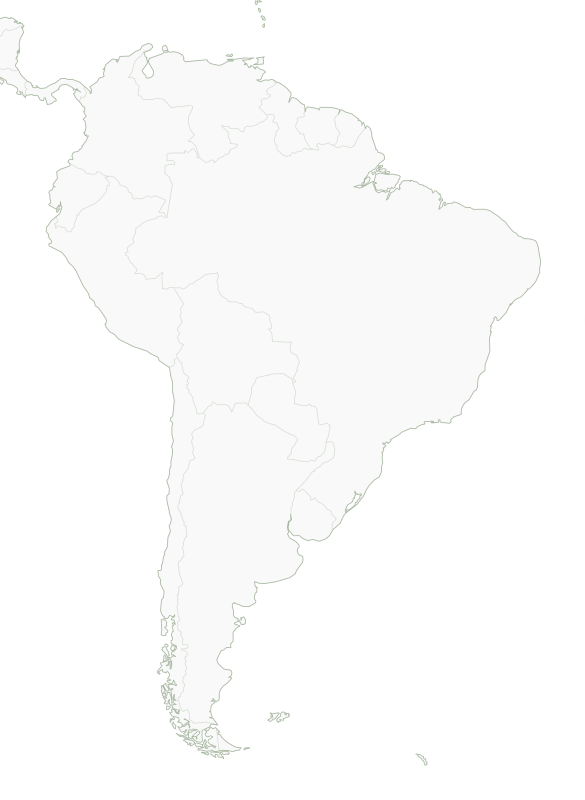
On the map
The major farming areas.
Key
- 1Cerrado
- 2Santa Cruz, Bolivia
- 3Eastern Paraguay
- 4Pampas
The markers are illustrative: they show well-known major farming areas in the region. They do not represent assets, farms or partners of Frontier Asset Partners. Base map: Natural Earth (public domain).
Other regions
Explore the other two continents.
Australia
Harvesting as the northern hemisphere heads into winter.
North America
Public data on soils and land prices, in a mature market.